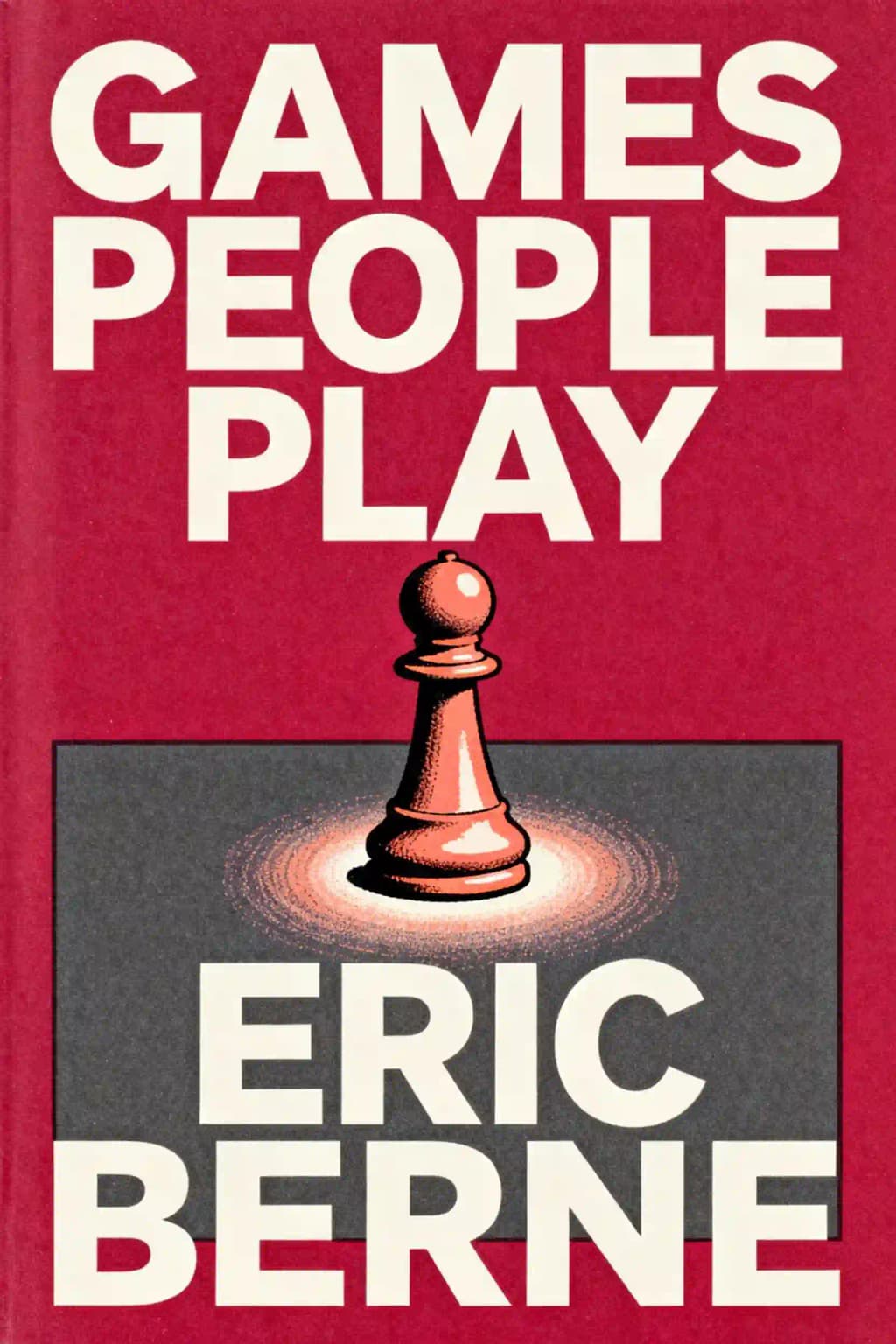
Games People Play
The Basic Handbook of Transactional Analysis
Overview of Games People Play
Discover why "Games People Play" revolutionized psychology, selling 5 million copies since 1964. Kurt Vonnegut praised this guide to hidden social dynamics that exposed why your daily interactions follow predictable scripts - and how to break free.

Key Themes in Games People Play
- transactional analysis
- ego state model
- ulterior motives
- social scripts
- psychological payoffs
Quotes from Games People Play
Games are series of ulterior transactions, repetitive, well-defined, and predictable.
Games prevent intimacy.
People play games to avoid intimacy.
Games are safer than intimacy, more exciting than pastimes, and provide psychological stability.
Games learned in childhood become automatic, with players genuinely unaware of their hidden motivations.
Characters in Games People Play
- Eric BerneAuthor and psychiatrist who developed the model
- Leonardo DiCaprioActor who used the book to understand characters
About the Author
About the Author of Games People Play
Eric Berne (1910–1970), the pioneering psychiatrist and bestselling author of Games People Play, revolutionized psychotherapy with his development of Transactional Analysis (TA). A McGill University-trained physician and former U.S. Army psychiatrist, Berne drew from psychoanalytic principles to create this accessible framework for understanding human interactions. His 1964 classic blends psychology and self-help, exploring how ego states—Parent, Adult, and Child—shape social transactions and relational patterns.
Berne’s rejection by the San Francisco Psychoanalytic Institute in 1956 catalyzed his groundbreaking work on TA, detailed in seminal papers and popularized through Games People Play. His theory became a cornerstone of modern psychotherapy and organizational communication, bridging clinical practice and everyday relationship dynamics.
Translated into numerous languages, Games People Play has sold millions of copies worldwide and remains essential reading in psychology curricula. Berne’s legacy endures through the continued application of TA in therapy, education, and corporate training—a testament to his vision of making complex psychological concepts actionable for all.
Download Summary of Games People Play
Get the Games People Play summary as a free PDF or EPUB. Print it or read offline anytime.
FAQs About This Book
Games People Play explores unconscious psychological "games" people use in relationships to avoid vulnerability, using transactional analysis to decode hidden motivations. Berne identifies patterns like "Now I Got You, Son of a Bitch" (blaming others for outbursts) and "If It Weren’t For You" (using partners as excuses), arguing these games stem from childhood scripts.
This book suits psychology enthusiasts, therapists, and anyone seeking to understand toxic relationship dynamics. It’s particularly valuable for recognizing self-sabotaging behaviors in personal or professional interactions. Berne’s accessible style makes complex Freudian-inspired concepts digestible for general readers.
Yes—despite criticisms of oversimplification, its frameworks remain relevant for analyzing modern communication, workplace politics, and social media interactions. Over 5 million copies sold attest to its enduring utility in decoding manipulative behaviors.
Key concepts include:
- Transactional analysis: Interactions (transactions) between people’s "Parent," "Adult," and "Child" ego states.
- Games: Repetitive exchanges with hidden agendas, like "Ain’t It Awful" (bonding through complaining).
- Scripts: Lifelong behavior patterns formed in childhood.
- “People pick… other people who play the same games”: Highlights how we attract matching dysfunction.
- “Awareness requires living in the here and now”: Urges breaking free from past-driven games.
- “Many games… the harder they play”: Links game intensity to psychological instability.
It decodes power dynamics like "Look How Hard I’ve Tried" (seeking praise through performative effort) or "Blemish" (focusing on others’ flaws to avoid accountability). Recognizing these games improves conflict resolution and team communication.
Academics argue Berne oversimplifies human behavior and uses anecdotal evidence. Critics note games lack empirical validation and may pathologize normal interactions. However, its pop psychology appeal persists for practical self-analysis.
While both explore childhood influences, Berne focuses on observable social transactions rather than unconscious drives. He replaces Freud’s id/ego/superego with ego states (Parent/Adult/Child) to map real-time interactions.
- “If It Weren’t For You”: Blaming partners for unmet goals to avoid self-responsibility.
- “Kick Me”: Provoking rejection to confirm negative self-views.
- “Courtroom”: Triangulating others to validate grievances.
Transactional analysis remains a toolkit in cognitive-behavioral therapy for identifying maladaptive patterns. Therapists use its framework to help clients recognize game roles (Persecutor, Victim, Rescuer) and shift to "game-free" intimacy.
Pair with:
- The Drama of the Gifted Child (Miller) for childhood scripting.
- Nonviolent Communication (Rosenberg) for game-free dialogue.
- Atomic Habits (Clear) for replacing destructive patterns.
It democratized psychoanalysis by replacing jargon with relatable examples (marital spats, office politics). Berne’s term "transactional analysis" entered mainstream lexicon, influencing later works like I’m OK—You’re OK.